Congratulations! You've looked at the numbers and company strategy and the payback is there. You've decided that you need a new warehouse, distribution center, or fulfillment center. You're planning on using a consultant, design firm, integrator, 3PL, or other partner to implement your vision.
But there are many challenges and risks in designing a new warehouse. Mistakes can cost a lot of money and take a long time to fix. Here's how you make sure you get ready to develop the right solution: Spend the right time collecting your basic warehouse design data.
Basic Data
A new warehouse can cost in the tens or hundreds of millions of dollars once you consider all the real estate, construction, material handling equipment, technology, and other costs. It is critical infrastructure for the your supply chain network. So it is critical that you design it to meet your needs.
Before going to engineers or systems vendors, collect basic data for your warehouse need. Basic warehouse design data are the fundamental requirements and assumptions that you need to proceed with design. Failure to collect good basic data is a leading cause of project failure.
As examples: In the design of a chemical plant, basic data might include things like detailed product characteristics and specifications, reaction temperatures, reaction products and by-products, and raw material composition and variability. For a petroleum project, basic data could include things like reservoir size, properties, temperature, pressure, and presence of faults. You get the idea: these are fundamentals to design and proceeding with the project.
This is a good practice for all warehouse design and start-up activities, even those without large automation systems. But larger systems are very complex. They require a lot of thought and design, and therefore many inputs, to get right.
Collecting basic data means finding key bits of information and agreeing on them within the organization. You'll have to provide this information to vendors for sizing equipment and systems. If they are working on information that is not right, you'll get a not-right solution back. Garbage in, garbage out. So it is worth real effort to get this step right at the start of the project. Otherwise you'll end up reworking it or being stuck with a bad solution.
A basic problem here is that the information has to be forward-looking. And remember, "It is difficult to make predictions, especially about the future." So historical data will inform your view, but you must think about what it means for the design.
There are two ways of developing information. You can use business forecasts. Or, you can find historical data and provide expectations to a design partner on how it will change in the future.
Either way, the important thing is to understand what you need the system to do.
Basic Warehouse Design Data List
Various warehouse experts put together lists of data to collect and calculations to run. Ed Frazelle's book World Class Warehousing is a great example that discusses data and profiles. Here are the types of information and data to assemble:
- Design volumes. All other design elements are downstream of throughput and volumes. Many vendors can extrapolate design volumes from historical data, if you give them assumptions on growth percentages. But this can be inaccurate when those design volumes don't match up with the company's internal strategy for growth. So it is best to get agreement on what the design volumes should be internally first and give those to the vendors to design to. Useful formats for design volumes are typically in Excel as a forecast or in a complete material flow diagram.
- Historical data such as processing volumes, with every significant dimension of those volumes. This means including information on all expected processes that the automation will have to consider. Raw data files for inbound orders and shipments, outbound orders and shipments, returns, etc, for at least 12 months are best. These should include fields like order numbers, order lines, SKUs, quantities, unit of measure / handling, modes of transportation, value-added services, pallet types handled, and so on. The purpose is to build all required operational profiles and in turn enable the engineers to analyze exactly how each dimensional and process product stream should be stored and handled. Products coming from profiling can include:
- Calendar & clock profiles can be determined from the raw data files or provided forecasts. It is important to understand the maximum volumes for a given month, day, week, hour, and sometimes even minute, and how much those maximums should be accommodated in the design. You'll also want to see how demand will vary across days, weeks, months, and the year. You'll hear terms like "peak-to-average" ratios when talking about your calendar profiles. Since design is marginally most expensive at the extremes of volume fluctuations, you'll want to know how much of your volume variability you plan to design for.
- Volumetric profiles will show what your storage and outbound handling capacity should handle.
- Handling-mix, Order, shipment, and customer profiles will form the basis of your outbound area and process design.
- Inventory and item-activity profiles: Determine how much of each SKU (usually communicated in days-on-hand of order volumes) will be in inventory during the year, which are the fastest movers, which items are associated with others on orders, and so on.
- Master data file, to provide all characteristics of every product such as weights and dimensions.
- Product information, such as descriptions of the product, pictures of what will be handled, and so on. This is to identify any product characteristics that may not be apparent elsewhere. Some products have different handling requirements; packaged food, shampoo, batteries, chocolates, soda, and produce all have to be handled differently. It should also include descriptions of pallets or other handling types to be used.
- Physical environment: Description of the building (if brownfield) or site studies (if greenfield), temperature, humidity, lighting, and other conditions that the operation will be in. This may require input from the Quality, Safety, and Packaging teams.
- Site infrastructure is an important part of the physical site and may include power and utilities connections and capacity, and fiber or internet circuit connection.
- Logistics Environment: Identify the modes of transportation, types of loads, and equipment that are expected. Define the expectations for live-load and drop-trailer usage. These will drive design elements like number of dock doors, yard size, gate requirements, and parking needs. Location traffic patterns and proximity to highways is important to understand too.
- Labor environment: If you will need to staff the site (and most warehouses do), it is important to gather data on availability and cost of labor for the job descriptions you'll be hiring for.
- System architecture: Depict the systems architecture that any vendors will have to integrate with.
- Process Descriptions of how each process takes place help potential vendors to understand the context of their solution and ask the right questions to make sure it integrates smoothly. These can be built out during design, but you will need an understanding of current processes to get to a future state.
- CAD drawings of the building or site that the system will go into. These enable vendors and building contractors to make accurate judgments about what equipment will fit.
- Label information: Obtain examples of labels to share with vendors, and pictures of where the labels are placed on the product. Dimensioned photos or drawings are best.
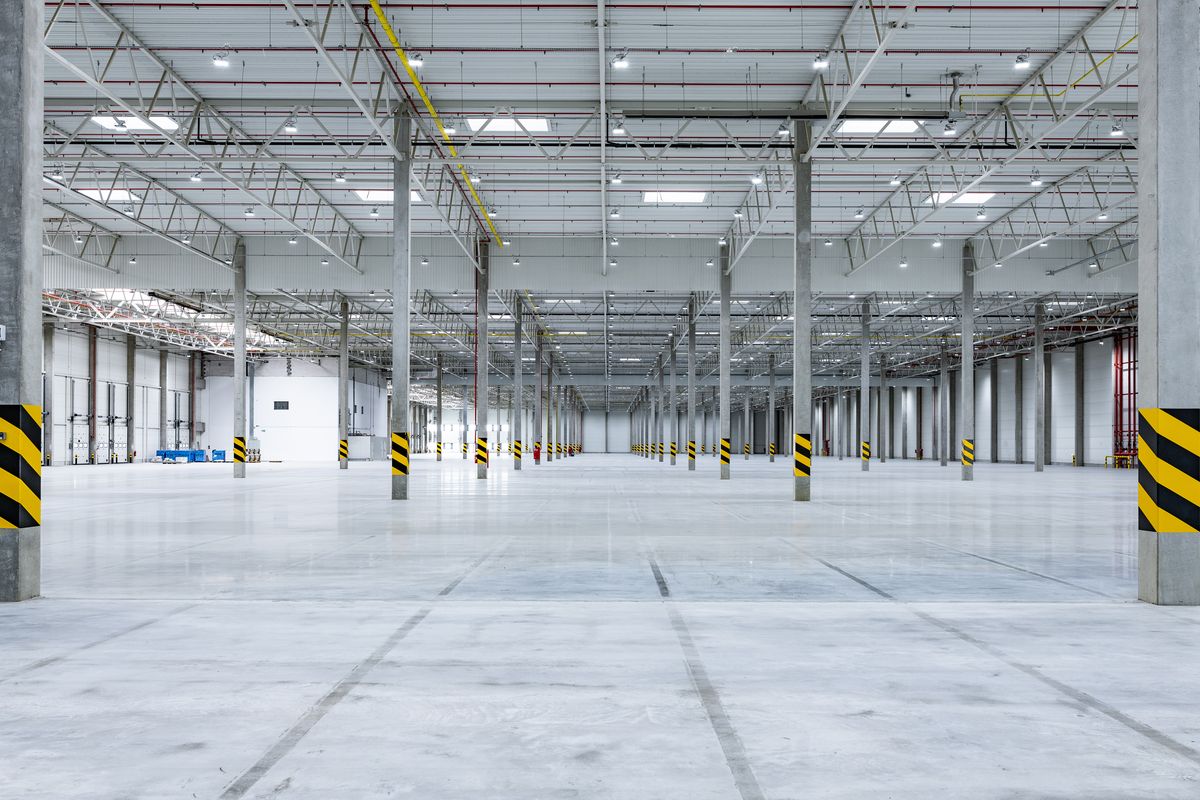
Thinking of moving in? You'd better know how high the ceiling is and how thick the slab is.
Basic Data Collection Mitigates Risk
There is a risk in warehouse design of getting it wrong. This doesn't happen intentionally, but when it does, the results can be catastrophic. What types of things can go wrong?
Maybe the solution vendor made assumptions about inventory profiles and designed a system with the incorrect number of storage positions. Or didn't realize that a certain type of pallet had to be handled. Maybe there was a miscommunication about pallet weights and now half of the installed racking can't be used, until an expensive retrofit is completed. Perhaps a miscommunication about overall design volumes meant that the entire facility was undersized.
These things can happen if you and the vendor design a system to the wrong requirements. Getting the requirements right in one of these systems is critical. Assembling and understanding your basic warehouse design data is how you get requirements right.
And when you get the requirements right, you're much more likely to build the right operational solution.
Use An Experienced Team
If you are working on a warehouse project, it's important to have someone who knows what to look for. Avoid the risk of ending up with the wrong thing, or having to fix mistakes. Get in touch with us today to start your design.
If you thought this was useful, be sure to subscribe for more insights. Contact PL Programs for expert project management in your warehouse operations implementations and improvement projects.