Inventory control is critical to operations in a distribution or fulfillment center. Delivering customer orders reliably and at predictable cost means having a good handle on quality, and inventory management policies and procedures--apart from solid direct operational processes--are key drivers of quality. Let's take a look at what makes a good inventory management program. We use this approach at PL Programs to inform our assessments and recommendations of inventory control programs.
Inventory Control Inside The Warehouse
Inventory control inside the four walls ("4-walls") of a warehouse is a slightly different thing than inventory management at a supply chain level.
At the supply chain level, inventory management means ensuring the correct amount of product in the right places to meet demand and minimize costs of stockouts and storage. This is at the intersection of supply chain planning and site operations planning.
At the site level, inside the 4-walls, "Inventory control" is the program that makes sure that inventory is available to ship and that site inventory levels can be confirmed by independent parties. "Available to ship" encompasses a whole range of activities to ensure that systematic records of inventory match the physical locations of inventory and that management has visibility to the location and status of all inventory.
Let's tackle those one at a time.
Inventory Control Program Checklist
Here is the short version:
The program must have:
- Inventory Verification through Physical Inventory or Perpetual Counting (cycle counting)
- Regular inventory reconciliation process in place (often done by cycle counts & problem-solving)
- Adjustment approval authorization and approval tiers in place (e.g. by what level of management for what level of dollars and/or number of units over a certain time)
- Process audits in place to determine process defect rates
- KPIs and Reporting
- see the list below for reporting
- Continuous improvement for defect elimination in place
- Documentation of the above program
Inventory Verification Can Be Done Two Ways
Operational sites must periodically be able to prove that what they're reporting as inventory can be verified. This is to meet requirements like SOX compliance, auditors' reports, or other financial verifications necessary for the company health.
One of the tenets of the inventory control program therefore must be "verifiability." Verifiability can be accomplished in a couple ways.
The first and most "old-school" method is by completing wall-to-wall, physical inventory counts. This is sometimes called "doing a PI." A physical inventory means that someone goes to each location and counts the SKUs in that location. At the end of the count, the totals are compared to a systematic or accounting record. Any discrepancies are reviewed and adjustments (with corresponding financial write-offs or additions) complete. The resulting records of inventory are used as the new start point for accounting and operations.
The advantage of Physical Inventories (PIs) is that they happen once, usually once per year.
But PIs have significant drawbacks.
First, they are a batch process. Because they happen only periodically, any discrepancies in the meantime will accumulate and cause problems to the operation.
Second, they are very disruptive and difficult to complete. They require an additional touch on every location. One way to do this is to send employees to count each location during operations. However, by the time that discrepancies are identified, transactions may have happened in the bin, making final reconciliation more difficult. Another technique is to shut down sections of the warehouse, or perhaps the entire warehouse, to complete the location counts. This avoids additional transactions that can complicate research and adjustments. But this results in operational disruption and impacts production.
Further, locations with issues must be counted multiple times. This is because humans counting introduces errors into the counts. So any defective location must be counted again, and perhaps multiple times. After many iterations of this, counting can take a long time and probably has errors at the end of it.
Physical inventories are costly, take a long time, impact production, and may not result in total inventory accuracy.
Another technique is cycle counting, or perpetual inventory counts. This is the practice of conducting periodic sampling of location records. Here is our description of cycle counts. Cycle counting locations results in a high level of confidence in the accuracy level of the inventory with minimal disruption to operations. It can be done by an A/B/C inventory value or velocity scheme to ensure inventory value is appropriately weighted in the counting.
The drawback is that it requires sampling math to be applied in the counting. It is harder to explain and intuitively grasp than doing a wall-to-wall PI. But it is just as, or even more valid than a full PI.
Inventory Reconciliation Drives Ready-to-Ship
The purpose of "ready to ship" is that inventory is available to pick when it is needed. For this to happen, physical and systematic records of inventory must match. We will refer to this as the "matching principle."
For physical and systematic records to match, all processes in the warehouse must have physical/virtual synchrony. From receiving through putaway, and picking through shipping, the physical moves of every piece of inventory must be tracked in the system.
How is this done?
First, lean processing principles should be applied. This means using one-piece flow where possible to scan items into and out of locations. Scanning equipment and a Warehouse Management System (WMS) should be used to track the moves. Paper can be used, but introduces a lag time into record-keeping.
Lean design principles should be used to keep processing as simple as possible. Processes should operate on a pull system where possible. The site layout should minimize transportation and handling, as each of those contributes to inventory errors.
Second, physical and virtual locations should match. It is sometimes tempting to move inventory into virtual locations for processing or problem resolution, but this leads to a physical/virtual mismatch and violates the matching principle. This means that there should be as few "virtual locations" as possible.

Adjustment Controls
Adjustments should be restricted and controlled. An adjustment is a systematic adding-to or taking-away-from of inventory. It affects the value of inventory on the company books. Controls on adjustments are an important control to identify and prevent theft or other unauthorized inventory changes.
A common way to control adjustments is to put role-based restrictions into the WMS system on who can complete adjustments of different values. A supervisor may be able to do adjustments up to a small dollar amount. A site manager may be required to approve higher value adjustments, and even higher amounts should be approved by a VP. This can be set up by single adjustment value and by total value of adjustments over a period of time.
Another subset of controlling adjustments is controlling access. Physical security and good password/system control acces is a critical part of ensuring that the right people have the right access to inventory and systems. Access control should be evaluated as part of an inventory control program. This ensures that product, especially high value product, doesn't disappear without a record.
Process Audits Identify Causes of Inventory Discrepancies
The operation should audit its processes. This means that each process step should be checked by an auditing department to establish and monitor the percentage of errors in the process. Errors should be researched and root causes eliminated.
Cycle counting can be considered one type of audit because it is checking bin inventory. Other types of audits include empty bin audits, receiving audits, shipping staging audits, pack line audits, pick cart audits, putaway audits... you get the idea. Each of these audits results in an idea of how many errors the process is introducing into the building.
A general format of an audit is to tick off the number of correct items and the number of incorrect items in a sample. If there are errors, then the error information should be recorded for further research. The total dataset can be reviewed to determine root causes as well as the current state of the process. Over time, process error rates can show improvement or decline.
Audits can be conducted by paper and pencil, in Excel, in dedicated apps like QualVis, or in the WMS.
Capturing audits by paper and pencil or in Excel are the most expedient methods. Unfortunately they are prone to getting lost, difficult to standardize across shifts, and don't roll up well into reporting at the site level. WMS-driven audits are the best solution but take a long time to develop, are expensive, and are hard to change. A purpose-specific audit app is the best solution but may require its own device and approval by IT.

Inventory Control Reporting
An output of audits is reporting. Reporting on inventory accuracy, adjustments, and process defect rates should be available to management. Inventory accuracy reporting can take several forms. It can be considered as:
- Net financial accuracy: The difference in counted site value over system value.
- Location accuracy: The percentage of (in)correct pickable locations over total pickable locations, depending on whether a defect rate or accuracy rate is desired.
- Inventory DPMO: The percentage of incorrect inventory records over total inventory records, usually expressed as a Defects-per-Million-Opportunities, or DPMO.
There may be other records of accuracy relevant to a specific site or sections of a site. Certainly there are other reports related to controlling inventory, such as aging reports, movement reports, turnover reports, and so on.
Here is a good baseline list of reports:
- Accuracy reporting at record, bin, and site level
- Adjustment reporting at site level to see all the adjustments and net effects.
- Inventory status reporting to see the inventory classified by status code. This will identify quality holds or other blocks that are preventing it from moving.
- Inventory turnover report
- Expiration & slow-moving SKU reporting: Understand expired (or soon-to-be-expired) and dead SKUs that should be moved out of the site.
- Stock movement report (receipts, transfers, adjustments, and shipments). This is to review all the ins-and-outs of inventory at the site.
- Inventory aging report: List of SKU Qty on hand by Receipt dates (or batches by dates). The idea is to understand what the oldest inventory on hand is.
- Fill rate report
- Exception reports, such as pick shorts and other errors or andons
But for accuracy, management will usually want some combination of #1 and #3 to get a picture of how accurate the site is within the 4 walls (which affects order fulfillment and metrics), and the overall write-offs that might affect financials.
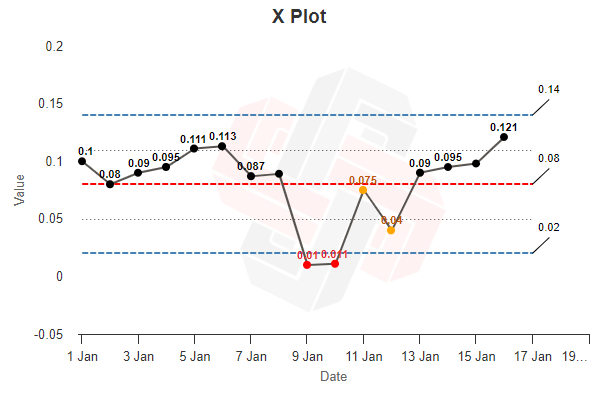
These metrics should also viewed over time series and in XmR charts so the site can understand normal variation.
Management System Integration
Great reporting isn't worth the paper it's printed on without a good management review system behind it.
Site management should have regular processes to review and evaluate the reporting, develop insights from it, action the insights, and confirm that they worked. This system can include daily, weekly, monthly, and quarterly reviews of inventory-related performance; PDCA and Kaizen cycles; and inventory-specific projects.
The site should have an Inventory Control / Quality Assurance Manager or similar role owning the inventory control functions and overseeing its execution.
Conclusion
There are many things that sites can do to optimize operations. They can do strategic slotting and product placement. They can have Lean processes, 5S'd shop floors, and highly efficient shift planning, volume planning, and execution.
However, the ability to get product out the door and meet the customer promise depends on being able to reliably handle inventory. Reliable inventory handling comes from strong process quality and inventory control. Poor inventory control will prevent sites from delivering to their customer promise. And along the way, they will have much more cost from rework and handling as they try to compensate for all the errors.
The techniques and approaches above will lay the foundation for your sites and facilities to have confidence in their system and site, and be able to deliver to your customers. If you want an outside assessment and custom recommendations to improve your site's inventory control program, set a meeting or send us a note!