Why is it that nearly 40% of major warehouse projects exceed budget or schedule targets? In a recent episode of The Warehouse Underground Podcast, our very own Paul Lukehart, founder of PL Programs, sat down with host Ben Hopkins to discuss what it truly takes to execute complex warehouse projects on time and on budget.
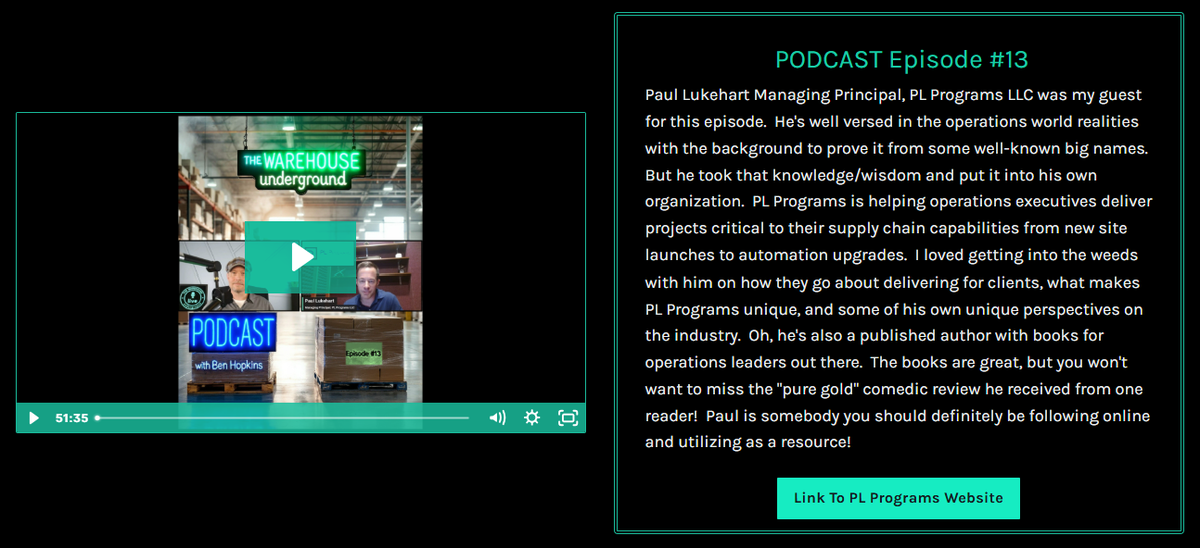
From warehouse startups to automation upgrades, the conversation offered practical wisdom for operators, project leads, and logistics executives alike. Here are the standout takeaways and how they reinforce PL Programs’ approach to execution.
Start with the Fundamentals: What Problem Are You Solving?
When warehouse projects veer off course, it’s often because teams leap into execution before they’ve defined the core problem.
As Paul put it, “It's more about really understanding the situation that the client is trying to solve.”
That clarity starts by asking the right foundational questions:
- What are we designing for?
- Do we understand the core requirements we’re trying to satisfy?
- Are we aligned with forecasts, volumes, and risk mitigation strategies?
- Do we have the right mix of skill sets to bring in the right perspectives?
Too often, large-scale warehouse projects suffer from misaligned expectations and incomplete data at the start. A tremendous number of billion-dollar and multi-billion-dollar projects fail, according to Paul. “40% of them are 25% over budget or schedule,” Paul noted. The common thread? Gaps in understanding business requirements and failing to account for volumes, flexibility, and integration from the start.
Paul emphasized that successful projects don’t begin with a vendor shortlist or a flashy demo; they start with the right questions. “You have your engineers, your consultants, your analysts... but you also need to know what you’re trying to achieve before you pick the technology.”
Understand the Terrain: How Ready Is Your Client or Organization?
Before mapping out stakeholder roles or building a timeline, take a step back and assess the organization's current standing. According to Paul, success often depends on how well the client understands what they want vs. what they’re ready to take on.
Paul shares several considerations:
- Has the organization done this type of thing before?
- Is it new technology? A new type of operation?
- What’s the timeline?
- The budget?
- How clear is their vision?
Not every client brings the same level of operational sophistication. Some are seasoned logistics players. Others are experts in their own business model but new to distribution. That difference shapes how much guidance they’ll need and where.
“Maybe they’re exceptional at branding or growth strategy, but they haven’t built out a DC before,” Paul said. That’s when PL Programs steps in to provide shape, structure, and guidance on the execution side, and they provide the business requirements.
PL Programs’ approach of meeting clients where they are helps bridge the gap between business strategy and operational design before governance and execution even begin.
Execution Lives or Dies by Governance
One of the hurdles Paul sees is the disconnect between strategy and execution. He shared how strong governance, clear ownership, structured meetings, and risk tracking are the backbone of complex warehouse implementations. Without it, even good teams can drift off course.
“I think everybody focuses on the robotics and the throughputs and the material flow diagram—and that is important. But if your team is not aligned, like you said, you’re going to fail,” Paul said. “If you go up to your executives with a new plan or a new budget request and stakeholders are not on board, it’s going to be very difficult for everybody.”
Stakeholders Are Not the Same. Stop Treating Them Like They Are.
Warehouse project failures often stem from stakeholder misalignment, not the technology. And that’s one of the first places things can fall apart. Warehouse projects typically involve operations, systems, IT, facilities, HR, and finance.
"That's another one of those risk factors and project failures. You have stakeholders who are opposed to some aspect of the project for a particular reason. They're not all rowing in the same direction. At that point, it's less about which technical solution is the best and more about aligning everybody. So you have to make sure that you identify everybody who should be engaged in the project and that you have a plan to engage them." Paul explained.
Each group has a different set of priorities. “You need to bring in stakeholders from all over, and everybody needs to be on the same page for the project to be successful.” When you align those perspectives early and often, with tailored communication for each, you build trust, reduce friction, and keep everyone moving toward the same goal.
What Does Stakeholder Risk look like? If you don’t engage the maintenance team on aspects such as the size of the maintenance area, including the equipment and their specific requirements, you will encounter problems later on.
Speed vs. Sustainability
Since distribution never stops, improvement projects often face pressure to move fast. Paul explains how this pressure can lead to costly shortcuts. “There’s a lot of pressure to produce results quickly. That’s hard to do when you're going through the design process, gathering information, or getting quotes. Taking shortcuts here may end up costing you 10X later.”
There's a difference between going fast and rushing. Rushing kills execution. Paul describes how PL Programs builds room into timelines for operational testing, cross-functional reviews, and leadership alignment, not as a luxury, but as insurance against costly failure.
Partners in the Work, Not Just the Plan
Paul contrasted PL Programs’ approach with that of larger consulting firms. "We’re not selling a process and moving on. We embed. We help you lead the work, not just document it. When we engage with clients, it’s more of a, ‘All right, let’s figure out what works for you. Let’s bring you the best experience that you can, within your constraints and your organization and your needs.”
That flexibility, combined with deep operational experience, makes PL Programs a powerful ally for organizations that need to move quickly, adapt in real time, and still meet their go-live goals. There’s always a moment when the warehouse team realizes this isn’t just a strategy deck, it’s going to change how they work.
Whether you’re planning a greenfield distribution center or upgrading a legacy WMS, the message is clear: success is in the details, and execution is where it counts.
Listen to the full episode at The Warehouse Underground Podcast, Episode 13
To learn more, follow PL Programs on LinkedIn and check out the content below: