In this post we'll cover creating a project plan for new warehouse implementations or startups. This post will cover the definition of a warehouse project plan and schedule, why it's important, what makes a good one, and what specific work should be included. It will also include our observations about key dependencies or quirks of the work.
This also applies to starting distribution centers, fulfillment centers, and reverse logistics centers. Much of the content also applies to moving facilities, shutting down facilities, or automation projects--just with slightly different focuses!
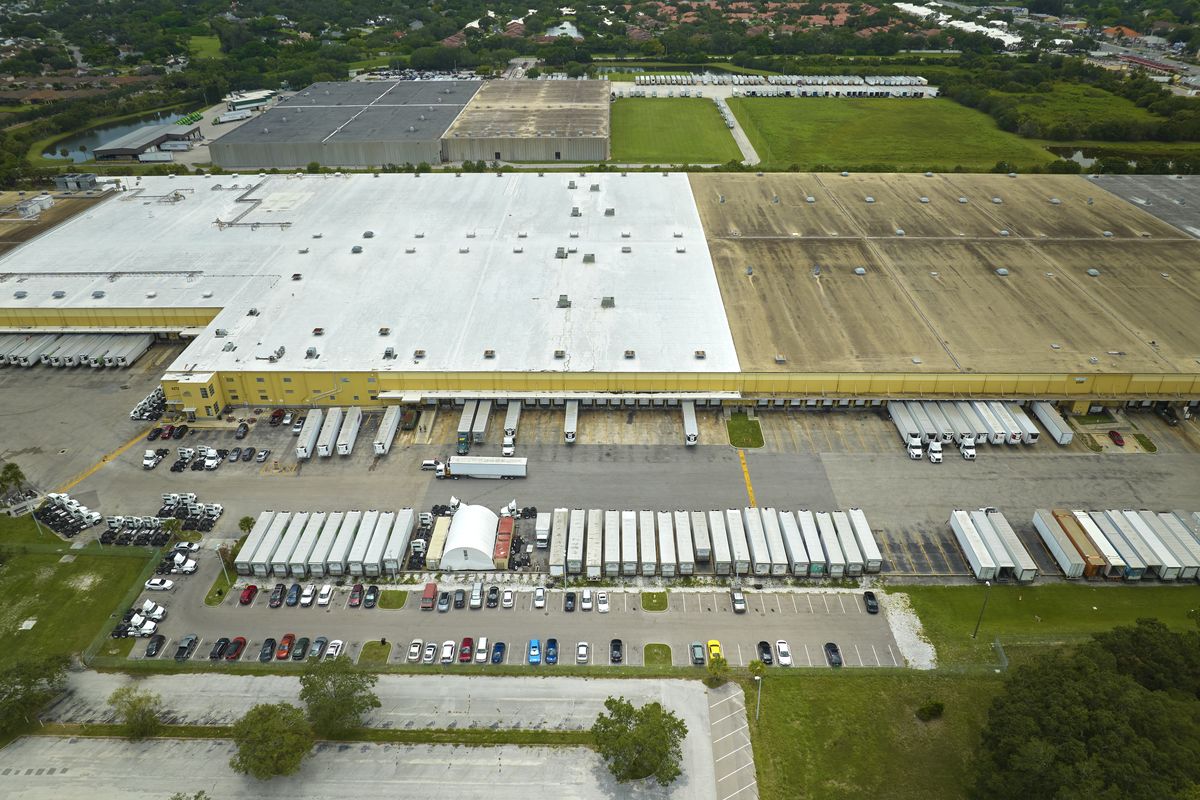
Top view of giant logistics center with many commercial trailer trucks. Starting these is no simple task!
What Is A Warehouse Project Plan
A warehouse project plan is the set of activities or tasks, along with their owners and time required, needed to accomplish the warehouse project.
A full "project management plan" can contain many other parts of a plan. For example, it could contain a Procurement Management Plan, Quality Management Plan, Communications Plan, Change Control Plan, Schedule Management Plan, and other sections. Developing and delivering that project management plan is the whole subject of the Project Management Body of Knowledge!
For this post, we are only talking about the project plan containing tasks, owners, and durations, as it pertains to warehouse projects. And specifically how it pertains to new warehouse (or distribution center, or fulfillment center...) start-ups.
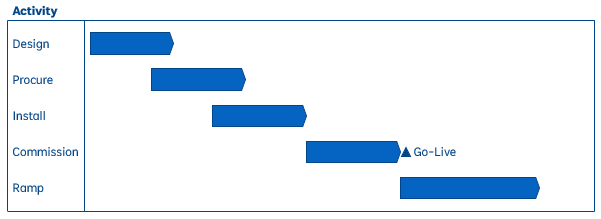
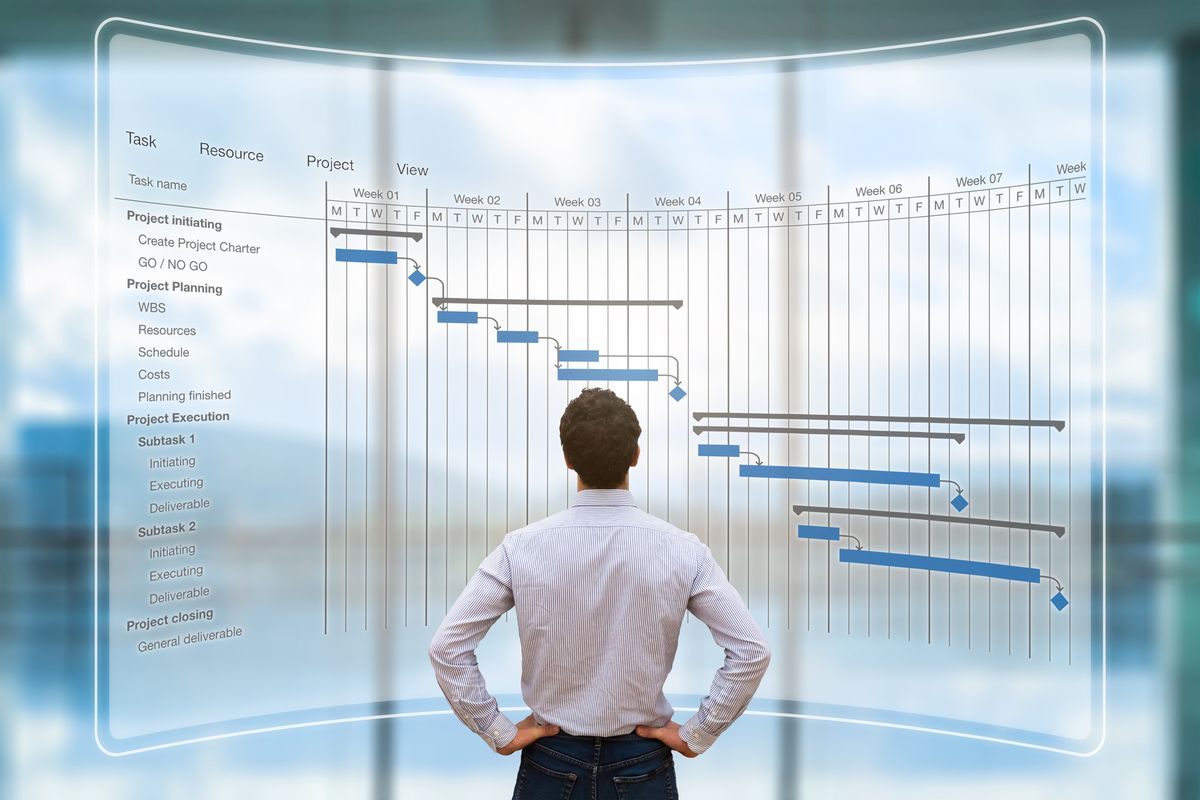
A good project plan helps everyone get on the same page.
Why A Project Plan Is Needed For Warehouse Projects
A good project plan is critical for tracking progress, coordinating activities, communicating status, and forecasting future events. The project plan or schedule is a critical part of the activities that the project management uses to plan and then control the project.
The plan becomes the reference for what should happen and when it should happen. It also becomes a tool to communicate to the project team, to executive management, and to other stakeholders.
You should ask for the project plan whenever there is a warehouse project going on. If the project manager can't produce it, then help him or her meet with the right people to get it set up and complete.
To be useful, the plan must be trustworthy, accurate, and contain the right information.
Characteristics Of A Good Project Plan
A good project plan (or schedule, I use the terms interchangeably here) should be:
- Complete: It should contain all the required work. In a warehouse project, this usually includes: Operations and strategy business case, design, construction, material handling equipment, IT systems, IT infrastructure, organizational readiness (including hiring and training), integrated testing, and setting up and operating the facility.
- Fully Linked: A logically-linked plan enables the plan to be used for setting baselines, tracking progress, and forecasting where the project end dates will be. This means the project can be used to assess risk levels. If the project is not fully and correctly logically linked, it cannot be used for tracking the critical path or forecasting. Leaders often ask for the Gantt chart and critical path - and they are asking for a logically linked schedule!
- Not High Level, Not Too Detailed: A project plan is part of a schedule hierarchy. Some schedules should be used for communicating with management. Other detailed schedules can be used by vendors or individual project members. The overall Project Plan should capture all the work to be done, but detailed enough to set up schedule task links, and not too detailed that it becomes unmanageable.
Project Plan Work Breakdown
The Project Plan work breakdown is how the scope, or work, on the project is identified and organized. This is usually done by starting with a workstream. A workstream is identified by a broad piece of scope to deliver. For example, "Permitting and Construction" is broad enough to cover the work involved in getting a warehouse built. "Facilities Enablement" is broader because it conveys a deliverable of getting the physical aspects of the warehouse operational.
Then the workstreams should be broken down into work packages. A work package is a deliverable that contributes to the overall workstream deliverable.
Finally, tasks are the parts of executing the work package that should be tracked.
Sometimes there are questions about whether tasks are too detailed. As a general rule, if you want to know whether a thing is done or you need to know it to track progress, it should be tracked as a task! So you might not need to know (or you might!) which labels are done in design, but you might need to know that "label design" is 80% complete.
Dependencies and Linked Tasks
Linking tasks is important in warehouse project plans. Linking shows the relationships between tasks in the plan. It is important to have a fully linked plan so that the software can forecast completion dates. No links, no forecasts.
Links should be considered between workstreams. It is important to consider and plan for the key interfaces between different pieces of work.
For example, "Demarc Point available" or "Ready for Equipment installation" or "server room clean and dust-free / ready for installation" could be milestones in the Construction workstream. But they are predecessors for IT Infrastructure work. So the IT infrastructure team must identify their key dependencies, and the project manager (and Construction lead) must make sure those dependencies are identified in the Construction plan.

The "shell drawings available" deliverable has a lot of successors, meaning it drives a lot of work!
That way, any changes to the construction schedule that impact IT are identified and clear.
This technique should apply continue throughout the whole plan.
External Dependencies
External dependencies are events outside the control of the project team that are predecessors for key project events. For example, inputs from other stakeholder project plans or business events can be listed. This is especially important if those events will cue work in the warehouse project plan.
Examples might be production, product launches, or key executive steering meetings. Or readiness of a vendor for User Acceptance Testing.
Another common example of this is a customer signature on a contract with a 3PL, which engages the 3PL project team, enables them to sign leases on buildings, and place other equipment orders.
Key Milestones
The warehouse project plan should include key milestones. Among others, business stakeholders are usually interested in:
- Project kick-off
- Certificate of Occupancy
- First receipt
- First shipment
- Operating at 100% capacity
There are many other "smaller" milestones that are good to track and report against, but those are the absolute minimum to have planned out.
Now let's get to looking at an actual plan!
Strategy and Operations Process
The Strategy and Operations workstream is where work related to defining the site requirements and processes is completed. This includes such work as:
- Defining the facility and business processes and business rules
- Logistics
- Yard management
- Inbound and receiving
- Putaway
- Replenishment
- Picking
- Sorting
- Packing
- Loading
- Shipping
- Detailed site requirement definition for throughputs, storage, and service levels.
- Sketching the site layout, and potentially a site Block Diagram, if engineering is involved
- Metrics definition (this is a key input to reporting!
- Operationalizing and Ramp planning
- Inventory Control
- Supply Chain Planning and Inventory Management
- Sometimes, Logistics work can fit in this workstream.
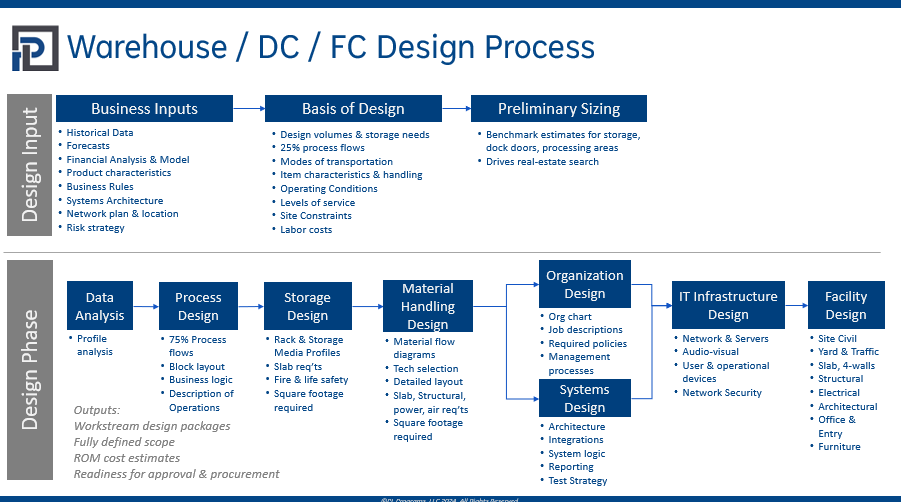
Facilities Enablement: Construction and More
Facilities Enablement is related to the work to actualize the four-walls facility. This can be a lot of scope! Let's take a look.
It can include:
- Site Design (including procurement for an architect or design firm)
- Permitting
- Construction, including site civil works, building construction of all classes, for both warehouse and office spaces, fire suppression, lighting, etc
- Warehouse Storage System, including racking and other material-holding equipment.
- Warehouse Material Handling Installation. This plus the storage system can easily be their own workstream. However, because there are so many dependencies between storage, material handling automation systems, warehouse design, and installation and commissioning of all the above, they fits nicely into Facilities Enablement under one workstream lead.
- Overall site layout, from block diagram through detailed design
- Automation such as ASRS, LGVs, wire-guided systems, conveyors, sorters, etc
- Forktruck procurement
- Dock equipment
- Physical Security, including access control, surveillance and monitoring
- Safety systems
- Furniture for both Office (e.g. desks) and Warehouse (e.g. workstations)
- General Warehouse Equipment, including operational, maintenance, janitorial, and waste management
- Signage and Markings - considering interior and exterior signage, wayfinding, traffic, etc
- Safety equipment
- Procuring, Contracting, and supervising site services such as: security, janitorial, pest control, pallet supply, landscaping, fire suppression and monitoring, security guards, yard jockeys, employee break concessions, maintenance engineers, recycling, mat & uniform cleaning, and so on.
Key milestones in this workstream include:
- Design milestones -
- Such as parameter definition;
- percentage design complete completion;
- Site utilities readiness
- Breaking Ground
- Slab ready for installation
- Building ready for equipment
- Demarc ready for site circuit(s)
- Server rooms ready for IT network and compute equipment installation
- Long-lead item order dates
- Long-lead items on a building can especially include steel fabrication, switchgear, and site utilities. Ask for a list of these items as you start planning construction.
- Long-lead item ship dates
- Temporary and Permanent Certificates of Occupancy
- The Certificates of Occupancy can be issued for different parts of a building at different times. So you may be able to get a CO for the office, or the warehouse, or temporary COs for those at different times. The local fire marshal will tell you what you can and can't do with them. Often, the full CO is required to start commercial operations in your building.
- Equipment installation start dates
- Equipment commissioning start dates
Much of the Facilities work is a predecessor for automation installation, training, and eventually integrated testing.
Logistics Automation
As we just mentioned, sometimes the material storage and the automation are put into their own workstream. This may make more sense depending on your organization or building need.
If this scope gets its own workstream, then the work packages include:
- Material handling automation: Procurement, design, installation, commissioning, integrated testing, ramping, acceptance
- Storage solution: Same steps! Storage solutions can have many profiles, so there may be many different pieces of storage hardware to procure, configure (physically and systematically), commission, and so on.
Key milestones in this workstream include:
- Design requirements definition
- Vendor selection complete and business awarded
- Order signed and down payment placed
- Detailed design complete date
- Equipment ship dates
- Installation dates
- Customer deliverable dates: What and When does the customer need to deliver something to keep installation on schedule? This section is especially important because the customer has responsibilities such as providing power connections at specified times and places to enable the vendor to do installation and testing. The customer must pay close attention to the customer deliverables sections of the vendor project plan.
- System testing start and complete
- Joint end-to-end and user acceptance testing (UAT) start and completion
- Ramp milestones
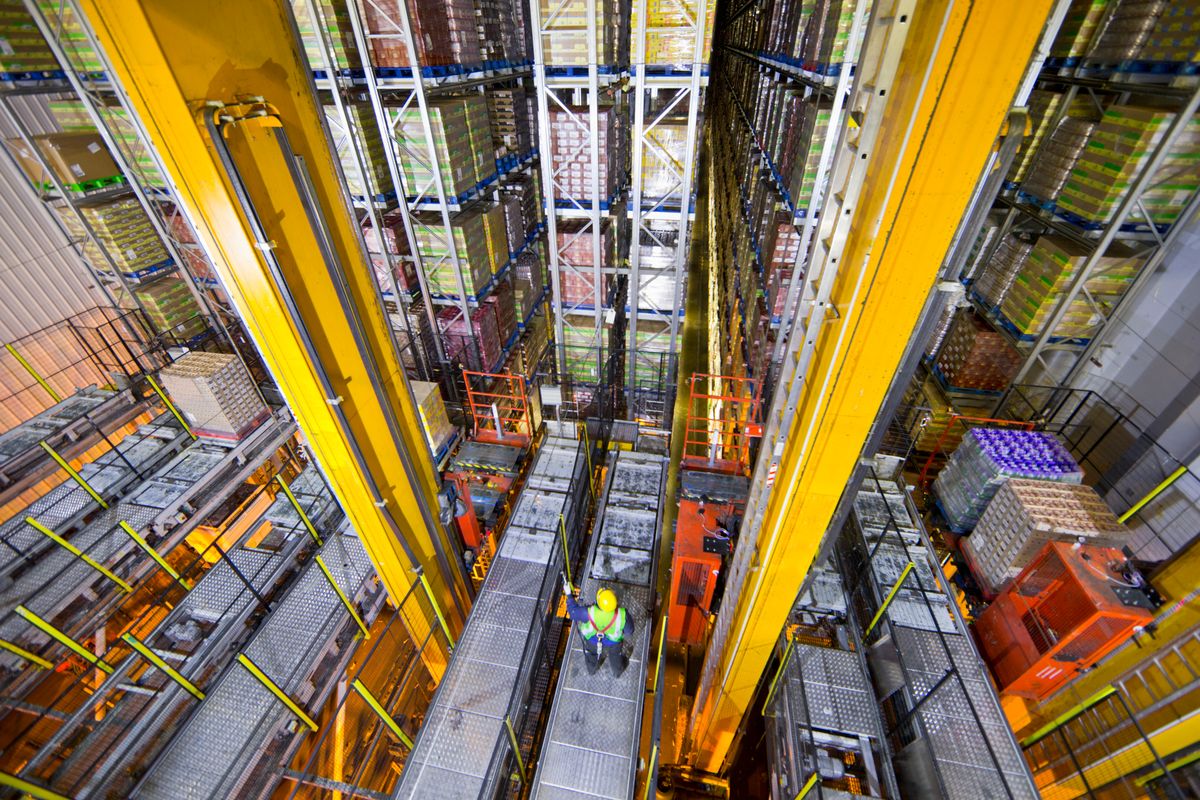
Automated Storage and Retrieval Systems are highly complex integrated systems.
Technology Deployment - Applications
IT projects are notoriously difficult to manage. For this reason, IT systems is its own set of scope, including the entire systems landscape and integration with vendors. This can include design, development, testing, and deployment for the whole system architecture. And it includes testing of the systems and system interfaces from low to high levels.
Work packages may include:
- Warehouse Management System (WMS) Design, Development, Config, Test
- "Design" includes operational functionality for the main warehouse processes such as receiving, putaway, replenishment, picking, sorting, packing, staging, loading and shipping. This then has to get translated into low-level design for any configuration or customizations needed.
- Reporting! Reporting is often neglected. These need as much design and attention as pick strategies!
- Label design: Labels and document design (and the systems to access them) must be carefully considered.
- Interfaces design and testing for all integrated systems such as Automation black-box or controls software
- Any related software such as middleware
- ERP configuration or customizations
- Transportation Management Systems (TMS) config or customization
- Human Resources Information System (HRIS) configuration
- Labor management system (LMS)
- Computerized Maintenance Management System (CMMS)
- Foreign Trade Zone (FTZ) software
- Yard management systems (YMS)
- Any other connected apps, such as yard management
Design for these systems will require participation from the Operations process decision-maker and input from the business and/or data analysts. The system is only as good as the requirements given to it!
IT Systems work is upstream of integrated testing. Testing of these systems is another major downstream activity that requires a lot of time, planning, and resourcing.
Tech Deployment - IT Infrastructure
Another critical IT "branch" is IT infrastructure. The best way of thinking about IT infrastructure is to segment it into three main sub-workstreams:
- Compute
- Servers
- Business continuity and failover testing
- Network
- Site circuits / T1 lines procurement and installation
- Wifi or other connectivity network (e.g. LTE or 5G) design, physical and virtual infrastructure installation, and testing
- Cabling
- Access Points
- VPN and secure tunnel setup
- Certificates
- Wifi Network coverage testing
- Workplace:
- User devices, such as thin-clients, monitors, scanners,
- Printers!
- Audio-Visual such as shop-floor displays, conference room setup
Some notable dependencies or constraints to IT Infrastructure include:
- Server room readiness (Dust-free, closed, clean, powered, fire suppression system complete and tested).
- Furniture setup complete: Tables, desks, and workstations must be present for hardware and cabling to go in!
- Sequencing dependencies from Facilities construction readiness, such as power availability, conduit completion, and painting completion in conference rooms. Many of the specific dates for installation can be coordinated at a low level between installation teams and with the site superintendent. But it's helpful to have a few major milestones for activity readiness.
IT Infrastructure work must typically be completed before UAT can happen. IT infrastructure is upstream of automation functioning and employees being able to access and connect to the systems driving the warehouse.
Organizational Readiness
Organizational readiness scope revolves around getting the company team ready for the new facility operation. This includes the employees within the four walls of the facility. It can also include change management and training for employees in other parts of the organization whose jobs are affected by the new facility.
Areas of scope for this workstream include:
- Organizational design
- Job descriptions
- Recruiting and hiring
- Training
- Policy update and definition
- Organizational Change Management (Communications)
There are dependencies from Org Readiness to Construction, to IT Infrastructure, and to Testing. There is also a lot of risk in the hiring timeline, so readiness for testing needs to be planned with slack.
These come from when thinking about how many employees there will be and what the facility requirements are.
Key milestones here include:
- Start date of Operations Lead (critical for completing process design and hiring tasks)
- First Operations Manager Start date
- Maintenance manager start date
- Hourly team member headcount started goals
- Testing dates
Hiring is upstream of testing, training, and operations.
Logistics
Depending on the project, pure logistics - that is, transportation - may not be a large part of the scope.
As a design input, logistics should consider the site volume and mix requirements in determining truck traffic throughput and parking requirements.
Transportation needs to be considered in startup activities. Key activities include carrier selection, onboarding, and label testing with parcel carriers. Training of transportation planners is also important if they fall under the onsite operations team.
Yard Jockey services may also fall under logistics. This means selecting, contracting, and training the yard jockeys to meet the operational coverage and throughput needs.
Integrated Testing
Integrated testing is the process of bringing all the workstreams together to test the final warehouse solution. This is critical to guaranteeing operability once the site "goes live."
Integrated testing milestones should include listing each test phase by date. Usually these will include:
- End-to-End (E2E) system testing
- User Acceptance Testing
- Cutover
Each of these test phases' activities can be defined differently from organization to organization and project to project. But the phases should be defined, agreed, and captured in the project plan -- and don't forget planning and add some time to fix bugs!
Everything is a predecessor of integrated testing. The facility must be complete, material handling installed, automation commissioned, people available... everything has to be ready if you're going to test the final warehouse solution!
Project Plan Example
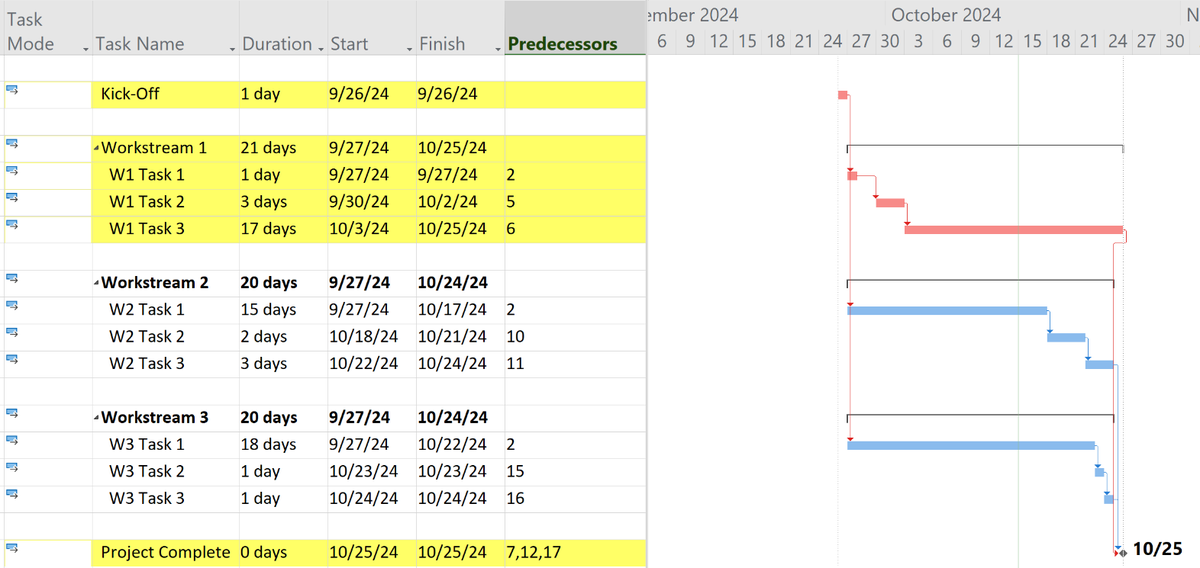
Here is an example draft template for a Warehouse Startup project plan. It is logically linked, contains much of the work to be done, and is tied to the work breakdown structure. (the file was shortened due to Wordpress constraints - rest assured, we didn't forget about IT or hiring or training or testing!)
Clearly the actual project plan will be different. It will have more detail, real durations, and the links will be reviewed. But this is the type of document you should look for in a warehouse project schedule.
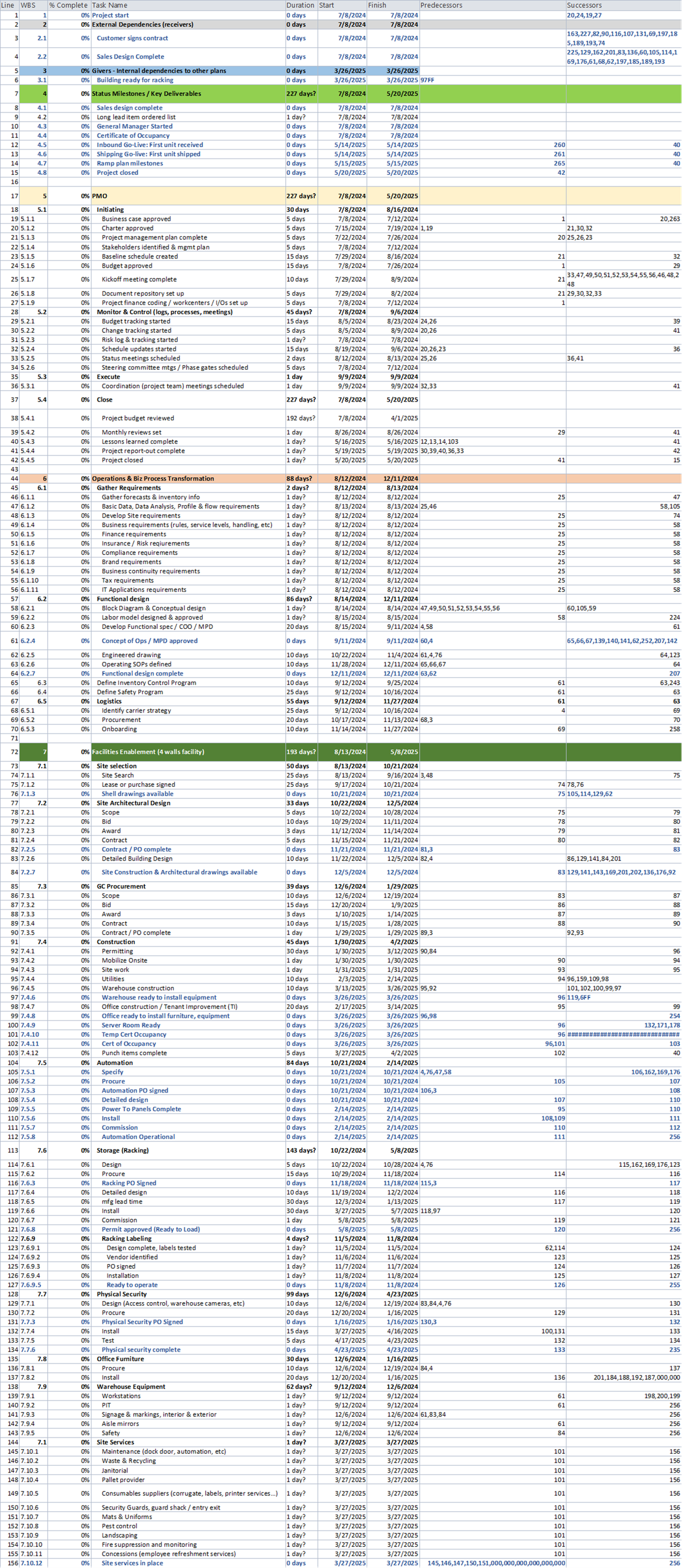
A Warehouse Project Plan Template Excerpt
A Project Plan Is A Critical Tool
For a warehouse project, a good project plan is an essential tool. It contains the information that the team needs to know about what is to be done, when it's planned, and who's doing it. It helps manage and communicate the status of the activities and helps your project succeed.
If you want a review of your project's plan, reach out to us at PL Programs for an expert and experienced partner. We specialize in site startups, moves, and closures of Warehouses, Distribution Centers, Fulfillment Centers, and Reverse Logistics centers.