Managing a project is like managing an operational processes. Like operational processes, projects are subject to variation and quality standards. And, similar to how an operation may audit its processes to ensure a high level of accuracy, projects may also be audited or given a "project health assessment" to ensure they're being managed correctly.
Most assessments of project management and performance focus on tracking output deliverables of the project like start-up dates, budget performance, and throughput metrics, but it's important to remember that the mechanics of project management are the sandbox or guiderails for those outputs. Crucially, the processes of project management can be viewed as leading indicators, or "weak signals", of the ultimate deliverable output; poor inputs in project management will likely lead to poor outputs when the project is delivered, so identifying those poor inputs early will help ensure that the delivered work is also acceptable.
Here's an example: Consider a $30-million dollar warehouse project to add an ASRS to a distribution center. If the program management isn't tracking the integrated schedule, or costs, or giving status to leadership, how confident are you in the project success? How likely is it that project ROI is impacted by poor project management?
You might think this is crazy, but it happens! Over-taxed, over-worked resources sometimes let the "formalities" of managing projects slip. The result is a lack of controls, lack of visibility, and ultimately a failed project.
So here's how to check your project process quality while the project is in-flight to ensure your processes are delivering quality outputs. Think of it as a Project Health Assessment; a high score on a project health assessment means that the best possible outcomes from the project are more likely.
Defining Project Success
The Project Management Institute recently updated its definition of project success. It is shown below. In essence, the success criteria are that the team and stakeholders hold the consensus that the project was worthwhile.
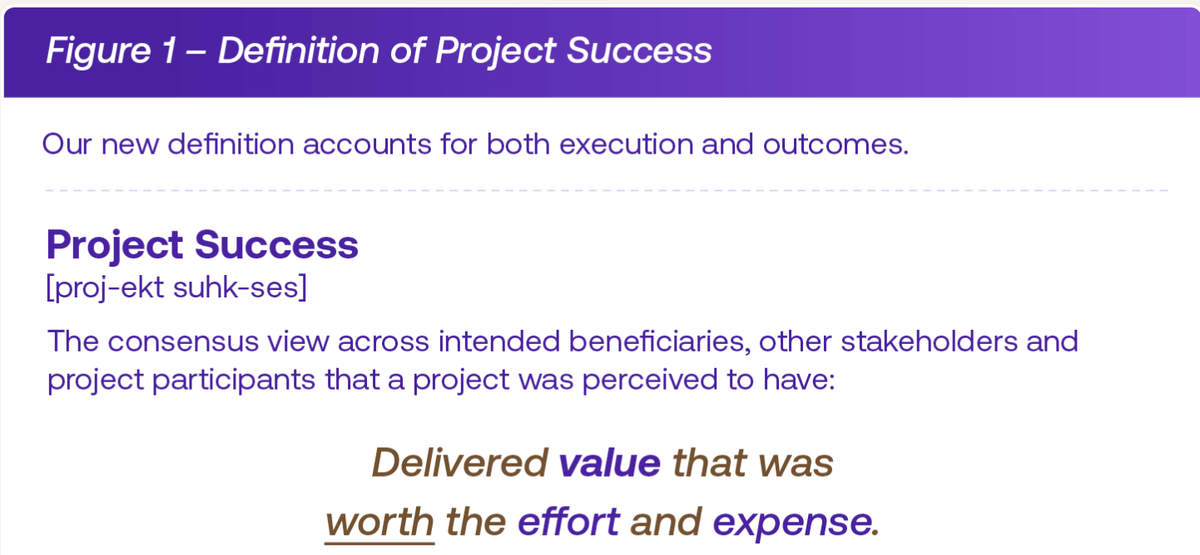
So this includes outcomes alongside the work and expense required to achieve those outcomes. This definition restated might be "cost-effective value, measured not only by dollars but by pain-in-the-butt factor." So a critical part of managing projects well is course-correcting on problems early on before they snowball into larger, more intractable issues.
Start Off Right: Baseline Project Documentation
Projects can also be thought of like buildings: a good foundation holds the rest of the structure up. The foundation for a project is contained in its baseline documents. Specifically, the project baseline documentation should include:
- An approved charter, containing the vision, goals, objectives, project owners, and scope description.
- An approved schedule estimate
- An approved baseline budget estimate (in as much detail as possible)
- Project management plan, containing agreed strategies and plans for managing the project
- A detailed description of scope, or as detailed as was available at the time
These products can be phased into existence, starting at a high-level and being refined over front-end-loading (FEL) or similar phase-gate processes for approval. But they must exist! Projects, especially those of any size or spend levels, cannot be executed on vibes or assumed visions. The need for basic planning and guiderails will very quickly become apparent.
Fortunately, these items are easy to check as part of a project health audit, and they only need to be checked once or whenever phase-gates are reviewed.
Blocking and Tackling: Basic Controls Checks
If the baseline documents are the foundation of the project, the basic controls are the framing and support structure.
What do "basic controls" include?
They should check that there are basic monitoring and escalation mechanisms for schedule and cost. (Why not scope? That's a separate discussion below!)
Specific mechanisms may vary from project to project, but common mechanisms include:
- Schedule: Project schedule is updated regularly with work progress and status to major milestones
- Cost: Actual spend on project is logged, coded, and reported. Contingency consumption is approved and recorded against budget.
- Communication controls: Team coordination meetings, Status, and Steering Committees are scheduled, attended, and used; notes with key decisions are sent out
- Risk management and control: If formal risk management methodologies are used, this can be included here too. The existence of a risk log
- Change Control: Does a change log exist? Is it up to date? Are change requests being formally approved and recorded in decision meeting notes?
These items can also be compiled into a checklist to review at project phase gate or steering committees. They become a sort of meta-log or diagnostic of whether the management processes are working.
10 Minutes Audit: Tracker Checks
If you have 10 minutes to check a project's health, then go to the PM document repository and ask for:
- Budget tracker
- Latest schedule
- Latest status report
- Latest Weekly Coordination meeting notes
- Change log
- Risk log
Action and decision tracking are also critical to execution. However, on large, complex projects they may be tracked in different places by workstream and may not be easily accessible.
Consolidated Checklist:
Below is the consolidated checklist of what to look for and when to check it. If you check these items and items are not present or processes are not being followed, then you should dig deeper to see that your initiative is on track.
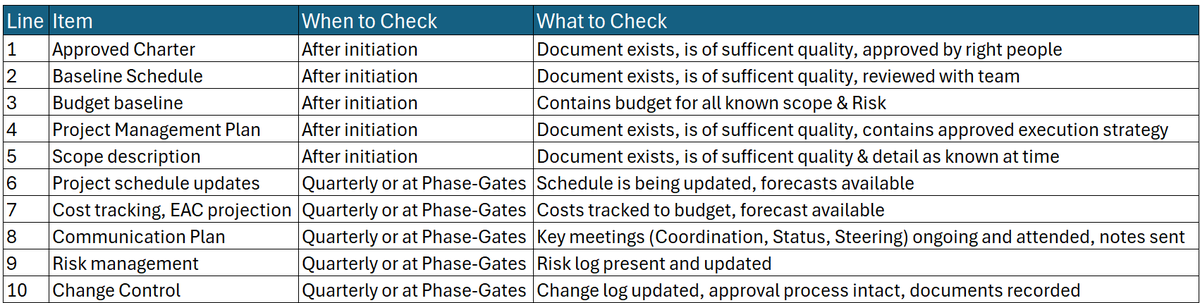
For project executives or owners, this is a good tool to periodically ensure that your project management is still on the ball.
For PMO members, it is a good reminder to review and ensure that your basic, fundamental processes are working as planned. Audit yourselves and see how you do!
PL Programs Runs Healthy Projects
This is important to us because it's what we do. We like making projects run like clockwork, and provide the right structure for project delivery. We specializes in delivering complex warehouse, distribution, and automation projects with your team. Contact us today to learn how we can bring the right level of rigor and expertise to ensure your program's success!